Ask most Christians to draw the story of the Bible and they will draw a straight line. Creation on the left, the cross in the middle, the new creation on the right. There is truth in that line, because history is going somewhere and Scripture insists on it. But a straight line cannot explain why the Bible keeps repeating itself. It cannot explain why Abraham goes down into Egypt during a famine centuries before his descendants do, why the prophets describe Babylon as a second Egypt, why Matthew says of a toddler carried home from the Nile that "out of Egypt have I called my son" (Matthew 2:15). The Bible does not read like a line. It reads like a wheel that keeps turning, and the question every serious reader eventually asks is whether that wheel is going anywhere.
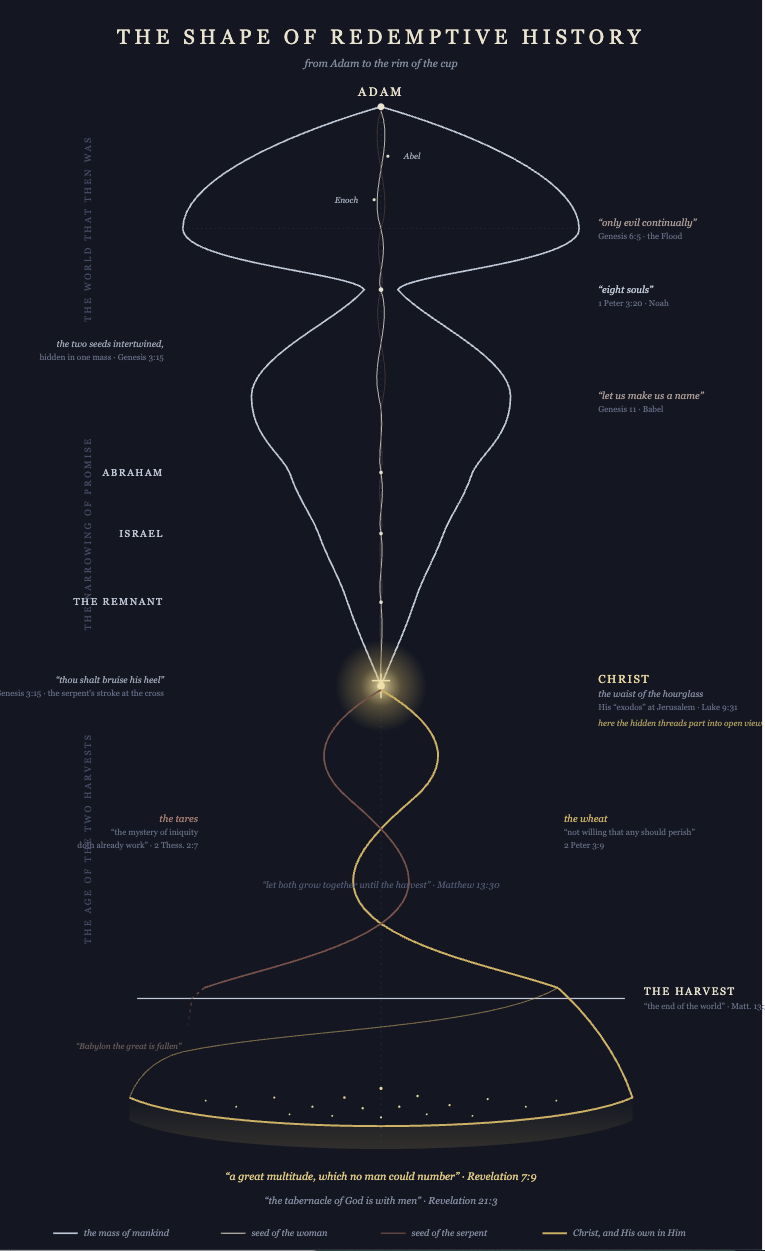
It is. The purpose of this teaching is to trace the shape the wheel makes as it rolls, because the shape itself is a sermon. Redemptive history is not a circle, where everything recurs and nothing resolves. It is not a simple spiral either. It is an hourglass. The story begins wide with all humanity, narrows relentlessly down to one Man, and then opens outward again from that one Man toward a multitude no man can number. When you see that shape, you begin to see where you are standing in it, and that changes how you read your Bible and how you understand the age you live in.
The Pattern that Keeps Returning
Where most eyes first catch sight of the redemptive pattern is the Exodus, and rightly so, for Scripture treats it as the master pattern of salvation. Bondage in Egypt, deliverance through blood and water, testing in the wilderness, rest in the promised land. Once you have learned that sequence you find it everywhere, and the remarkable thing is that you find it before the exodus ever happens.
In Genesis 12 a famine drives Abram down into Egypt. Pharaoh takes what is not his, the LORD plagues Pharaoh's house with great plagues, and Abram comes up out of Egypt "very rich in cattle, in silver, and in gold" (Genesis 13:2). That is the national exodus in miniature, acted out by one household four hundred years early. The pattern runs again in Joseph's generation, and here it runs with a twist worth noticing. Famine again strikes Canaan, and this time Egypt is the place of provision rather than the place of bondage, because a rejected brother has gone before his family and been exalted to the right hand of the throne. Before the sons of Jacob can dwell under his provision, their sin must be dragged into the light. "We are verily guilty concerning our brother," they confess in Genesis 42:21, and Judah's great intercession in chapter 44 completes the exposure. Guilt confessed, the rejected one revealed as savior, the family brought through testing into a land of bread. The furniture of the exodus is all present even though the geography has traded places, which teaches us that "Egypt" in Scripture is less a location than a condition. It is wherever bondage or refuge meets the people of God, and the pattern of deliverance through testing holds regardless of which direction the caravan is traveling.
The prophets then take the pattern and throw it forward. When Israel is carried to Babylon, Isaiah announces the return home in deliberate exodus language, invoking "the LORD, which maketh a way in the sea, and a path in the mighty waters" before promising, "Behold, I will do a new thing" (Isaiah 43:16, 19). Hosea goes further and makes the wilderness itself a place God brings His people back to on purpose: "Therefore, behold, I will allure her, and bring her into the wilderness, and speak comfortably unto her" (Hosea 2:14). The wilderness is not a corridor Israel passed through once. It is a station on a wheel the LORD keeps turning, the place where He strips His people of their idols and speaks to their hearts.
So the reader who senses that the Bible moves in cycles is reading well. But a cycle alone is a pagan idea. The nations surrounding Israel believed in eternal recurrence, seasons and empires and ages rolling forever without destination. Scripture takes the wheel and does something no pagan cosmology ever did. It makes the wheel roll toward a point.
Not a Circle but a Narrowing
The Exodus is where the pattern becomes visible, but it is not where the pattern begins. Step back before Sinai, before Egypt, before Abram ever left Ur, and you find the shape already laid down in God's purpose from the first pages of Genesis. What the Exodus displays in history, Eden decreed in promise. In Genesis 3:15 that promise is as wide as the race itself, a seed of the woman who will bruise the serpent's head. Humanity expands from Adam, and what expands with it is corruption, until "GOD saw that the wickedness of man was great in the earth, and that every imagination of the thoughts of his heart was only evil continually" (Genesis 6:5). Then comes the first great compression. The entire race is narrowed to eight souls in an ark. Peter marks the number himself, "wherein few, that is, eight souls were saved by water" (1 Peter 3:20). The world that then was perished, and the future of mankind passed through a waist the width of one family.
A caution belongs here, because the shape can be misread. The wide outline of the early story is not divided into a righteous side and a wicked side. The whole mass was corrupt, and Genesis 6 makes no exception for the width of the vessel, only for one man inside it, for "Noah found grace in the eyes of the LORD" (Genesis 6:8). The narrowing, then, is not a filter straining the deserving out of the undeserving, as though eight souls survived the Flood because they qualified. It is election threading a promise through a fallen race. God keeps choosing a narrower channel through which the seed of the woman will run, and every channel He chooses confesses its own unworthiness. Abraham was called out of a house that "served other gods" beyond the river (Joshua 24:2). Israel was told flatly that the LORD did not set His love upon them because they were more in number than any people, "for ye were the fewest of all people" (Deuteronomy 7:7). What runs down the hourglass is not the merit of the few but the faithfulness of the One choosing them.
And within the wide corrupt mass there was always a hidden thread. Abel and not Cain, the line of Seth calling upon the name of the LORD, Enoch walking with God, the seven thousand in Elijah's day who had not bowed the knee to Baal, whom even the prophet could not see. Paul gives the principle its sharpest form: "they are not all Israel, which are of Israel" (Romans 9:6). Before Christ, the people of God are not a visible body alongside the world but a seam of grace hidden inside it, known fully to God alone, running unbroken through generations that mostly did not know it was there.
Humanity spreads out again from Noah and corrupts again at Babel, and this time the narrowing comes with a judgment attached. God scatters the nations and, as Moses later explains, divides the host of heaven “unto all nations under the whole heaven: But the LORD hath taken you… to be unto him a people of inheritance” (Deuteronomy 4:19-20). He hands the rebel nations over to lesser spiritual powers and takes a nation of His own, for “the LORD’s portion is his people” (Deuteronomy 32:9). That is why the very next thing that happens in Genesis is the call of one man from Ur.
Out of Abraham's sons, Isaac and not Ishmael. Out of Isaac's sons, Jacob and not Esau. Out of Jacob, one nation, and when the nation breaks covenant the prophets narrow it further still to a remnant, the she'ar who will return. Isaiah keeps compressing until the remnant thins to a single figure, a Servant who is Israel in one person, of whom it is written, "Surely he hath borne our griefs, and carried our sorrows" (Isaiah 53:4). By the opening of the Gospels the compression is complete. The whole story stands at the width of one Man in the Jordan river, one Man in the wilderness forty days where Israel failed forty years, one Man on a hill outside Jerusalem. Luke tells us that on the mount of transfiguration Moses and Elijah spoke with Jesus of "his decease which he should accomplish at Jerusalem" (Luke 9:31), and the word Luke chooses for decease is exodos. The cross is the exodus of the exoduses. Every previous turn of the wheel was rehearsal for this.
Irenaeus of Lyons, writing in the second century, gave this narrowing its classic name. He called it recapitulation, drawing on Paul's word in Ephesians 1:10, that God would "gather together in one all things in Christ." Christ, Irenaeus argued, passed through every stage of Adam's story and Israel's story in order to redeem each stage from within, succeeding at every point where they had failed. The hourglass has a waist, and the waist is a Person. All the sand of the old world ran down to Him.
The Age of the Two Harvests
Here a natural question arises, and it deserves a careful answer. If history narrowed to Christ, what shape has it taken since Him? Are we narrowing again toward His second coming the way Israel narrowed toward His first?
The answer of the New Testament is no, and the reason is glorious. The compression never needs to happen again, because the work accomplished at the waist is finished. What happens after Christ is expansion. The One becomes twelve, the twelve become a hundred and twenty in an upper room, the hundred and twenty become three thousand at Pentecost, and the commission drives the widening outward "in Jerusalem, and in all Judaea, and in Samaria, and unto the uttermost part of the earth" (Acts 1:8). And notice who was standing there listening at Pentecost, “devout men, out of every nation under heaven,” each hearing the wonderful works of God in his own tongue (Acts 2:5-6). Babel is being reversed. The nations God handed over at the scattering are the very nations the gospel now goes out to reclaim, which is why the risen Lord aims the commission at “all nations” and why the multitude around the throne is drawn from every one of them.
John is finally shown where the widening ends: "a great multitude, which no man could number, of all nations, and kindreds, and people, and tongues" (Revelation 7:9). The bottom of the hourglass is wider than the top. More sand comes out than went in, because the Man at the waist is not merely a survivor of the old world but the firstborn of a new one.
(Some manuscripts of Deuteronomy 32:8, including the Dead Sea Scrolls, read that God set the bounds of the nations “according to the number of the sons of God,” making the disinheritance explicit. The KJV follows the Hebrew text that reads “children of Israel,” but the doctrine stands on Deuteronomy 4:19-20 either way.)
But the New Testament will not let us describe this age as a single widening stream of light, and any teaching that does so will leave believers confused about the evil they see maturing around them. Jesus describes the present age in the parable of the wheat and the tares, and His instruction to the servants is the key to the whole era: "Let both grow together until the harvest" (Matthew 13:30). Two crops are ripening in the same field at the same time. The gospel spreads to all nations, and Jesus ties the end of the age to the completion of that spread (Matthew 24:14). Yet in parallel, Paul writes that "the mystery of iniquity doth already work" (2 Thessalonians 2:7) and foresees its final concentration in a man of sin. Revelation shows both maturities side by side, wickedness gathering itself into Babylon and the beast even as the redeemed multitude grows past counting.
Notice what this means for the shape. The division between the two seeds did not begin at the cross. It was declared in Eden, the enmity God Himself set between the seed of the woman and the seed of the serpent. But before Christ it ran as that hidden seam inside one covenant people, remnant within nation, Jacob within Isaac's house, wheat and chaff on one threshing floor. What the cross accomplished was not the creation of the division but its clarification. The hidden thread that ran down the whole upper hourglass emerges from the waist as a visible body, a people called out and named, filled with the Spirit, distinguishable in the world even while still mixed among it. The two seeds now grow as two maturing crops with two heads, Christ and the man of sin, and history has become the open contest that Genesis 3:15 announced in seed form.
Augustine saw this clearly and built The City of God upon it. Two cities, he wrote, formed by two loves, growing intermingled through the whole course of history until the last judgment separates them. The age we live in is not the triumphal shrinking of evil, and it is not the tragic shrinking of the church. It is the simultaneous ripening of both harvests. This is why the world can be genuinely getting darker and the kingdom genuinely advancing at the same time, and why neither observation refutes the other. The delay of the second coming is not slackness but patience, for the Lord is "not willing that any should perish, but that all should come to repentance" (2 Peter 3:9). The widening of the wheat is the very reason the harvest has not yet come.
What narrows toward the second coming, then, is not the church and not the promise. It is history itself. Both crops come to a head at once, and the sickle answers the ripeness of each. "The harvest is the end of the world" (Matthew 13:39). At that harvest the tares are bound and Babylon falls in one hour, and the wheat is gathered into a barn that turns out to be a city, and the city turns out to be a garden, and the garden turns out to be a temple, for "the tabernacle of God is with men, and he will dwell with them" (Revelation 21:3). The first advent is the waist of the hourglass. The second is the rim of the cup.
Reading Your Bible by the Shape
his framework is not merely elegant. It disciplines our interpretation, and it locates our lives.
It disciplines interpretation because typology without an anchor drifts into fanciful thoughts. Once you know the shape, every cycle in Scripture can be tested with three questions. What is the Egypt, the bondage from which God delivers? What is the wilderness, the testing ground where sin is exposed and dependence is learned? What is the rest being offered?
Then ask where the passage sits relative to the waist of the hourglass. Everything before Christ compresses toward Him, so its types find their fulfillment in Him. Everything after Christ expands from Him, so its promises reach the church through Him. The center is fixed, and because the center is fixed the pattern cannot be bent to say whatever we please. Each turn of the wheel also carries more accumulated promise than the last, Noah's preservation, Abraham's seed, Moses' dwelling presence, David's throne, Jeremiah's law written on the heart, until all of it is gathered into one Person and poured back out on His people.
Walking the Map Yourself
The believer does not read this shape from outside it, and Paul says so in as many words. After rehearsing the exodus, the sea, the manna, the rock, and the wilderness deaths, he writes, "Now all these things happened unto them for ensamples: and they are written for our admonition" (1 Corinthians 10:11). The word behind "ensamples" is typoi, types. Israel's journey is a divinely drawn map of the Christian life. That is why Hebrews preaches the wilderness generation to the church, and why Bunyan in his book The Pilgrim’s Progress could send a pilgrim down the same road.
So trace your own position on the map. Your Egypt was the bondage of condemnation, and you left it at conversion, when God "delivered us from the power of darkness, and hath translated us into the kingdom of his dear Son" (Colossians 1:13). The blood on your doorposts is the blood of the true Passover Lamb.
Then comes the wilderness, the long stretch where trust is learned. Hosea says the wilderness is where God allures His people in order to speak comfortably to them, so the dryness and testing of this season are not signs of His absence. They are the appointed place of His courtship.
And yes, there is a real entering of the land in this life. Hebrews puts the rest in the present tense before it ever puts it in the future: "we which have believed do enter into rest" (Hebrews 4:3), and Jesus offers it now, "Come unto me... and ye shall find rest unto your souls" (Matthew 11:28-29). A believer can truly cross Jordan into a settled, mature walk, a season where trust has been learned, where Christ has been let all the way in, and where God works freely through a surrendered heart. But remember what kind of country Canaan was. It had to be taken city by city, so the rest of the land is a rest with battles in it, some fought within the heart and some fought outside it as we labor to bring others in. Think of the grapes of Eshcol, carried back on a staff before Israel ever crossed over. The peace a mature believer tastes now is not a picture of the promised land. It is promised-land fruit eaten early, which is what Paul means when he calls the Spirit "the earnest of our inheritance until the redemption of the purchased possession" (Ephesians 1:14).
Even so, the land we enter now is not the last one. Abraham dwelt in Canaan itself and was still a stranger and pilgrim there, "for he looked for a city" (Hebrews 11:10). Joshua brought Israel in, yet "there remaineth therefore a rest to the people of God" (Hebrews 4:9). Creation itself groans between exodus and entry, "waiting for the adoption, to wit, the redemption of our body" (Romans 8:23). The final rest is seeing Him.
Can We Go Back to Egypt?
Here an honest question presses in. If the journey can be walked forward in this life, can it be walked backward? Can a believer end up in Egypt again?
Scripture answers with a distinction that must never be blurred. In terms of your standing before God, no. The sea is crossed once. Paul calls conversion being "baptized unto Moses in the cloud and in the sea" (1 Corinthians 10:2), and there is no un-baptizing, for "there is therefore now no condemnation to them which are in Christ Jesus" (Romans 8:1).
But in terms of daily experience, yes, and Scripture is loud about it. Israel said it openly, "Let us make a captain, and let us return into Egypt" (Numbers 14:4). Paul asks the Galatians the same question in the present tense: "how turn ye again to the weak and beggarly elements, whereunto ye desire again to be in bondage?" (Galatians 4:9). Through unbelief, fear, or the slow drift of circumstance, a Christian can wander back into old chains.
What he cannot do is re-enter Egypt as a condemned slave. He goes back as a free man living beneath his deliverance. And what follows is not a second redemption, because the first one holds. What follows is the discipline and gentle pursuit of a Father who says, "I will heal their backsliding, I will love them freely" (Hosea 14:4). The cycles within the Christian life are the shepherd's cycles of Psalm 23, "he restoreth my soul," and they turn inside a covenant that does not cycle. You may repeat the wilderness. He will not repeat the cross.
What your Longings are Telling You
There is even a way to take your own bearings on the map, because Scripture treats longing as a signpost of location.
In Egypt, Israel "sighed by reason of the bondage, and they cried" (Exodus 2:23). That is the groan of a soul that wants rescue. In the wilderness the craving flipped into nostalgia: "We remember the fish, which we did eat in Egypt freely; the cucumbers, and the melons, and the leeks, and the onions, and the garlick" (Numbers 11:5). Mark that word freely. They were slaves whose sons had been thrown in the river, yet memory had edited out the bondage and kept the flavor. That is the anatomy of every temptation to go back. Sin is remembered selectively.
Later the complaint changed fruit: "no place of seed, or of figs, or of vines, or of pomegranates" (Numbers 20:5). Now they were craving promised-land produce, the very clusters the spies carried back from Eshcol. The longing was aimed at the right country but sung in the wrong key, murmuring against God instead of hoping in Him. The same longing, sanctified, becomes Psalm 84, "my soul longeth, yea, even fainteth for the courts of the LORD," and the pilgrims of Hebrews 11:16 who "desire a better country, that is, an heavenly."
So ask two simple questions. What have I been craving lately, rescue, a falsely remembered Egypt, or the fruit of the country ahead? And in what key does the craving sing, murmuring or hope? Your cravings tell you where your heart is camped. Their key tells you whether it is walking with God or against Him.
The Wandering Years are Shepherded Years
When you feel the repetitions of your own life, the same struggles returning, the same lessons taught again at deeper cost, you are not going in circles even when it feels that way. Deuteronomy 8:2 says God led Israel those forty years "to humble thee, and to prove thee, to know what was in thine heart." Even the wandering years were shepherded years, the cloud still leading, the manna still falling, their raiment not waxing old upon them.
The God who governs the great spiral governs the small ones. He brings His people back through familiar territory because each pass is meant to carry them further in, closer to the waist, more conformed to the Man who stands there. The wheel is rolling somewhere. It is rolling toward a harvest, a cup filling with a multitude no man can number, and if you are in Christ your name is already written on the rim.
"For as in Adam all die, even so in Christ shall all be made alive. But every man in his own order: Christ the firstfruits; afterward they that are Christ's at his coming." (1 Corinthians 15:22-23)